
Wine Explorers Club - Champagne's Geological Geek: The Allocated Legrand-Latour Bottlings
Wine Explorers Club - Champagne's Geological Geek: The Allocated Legrand-Latour Bottlings
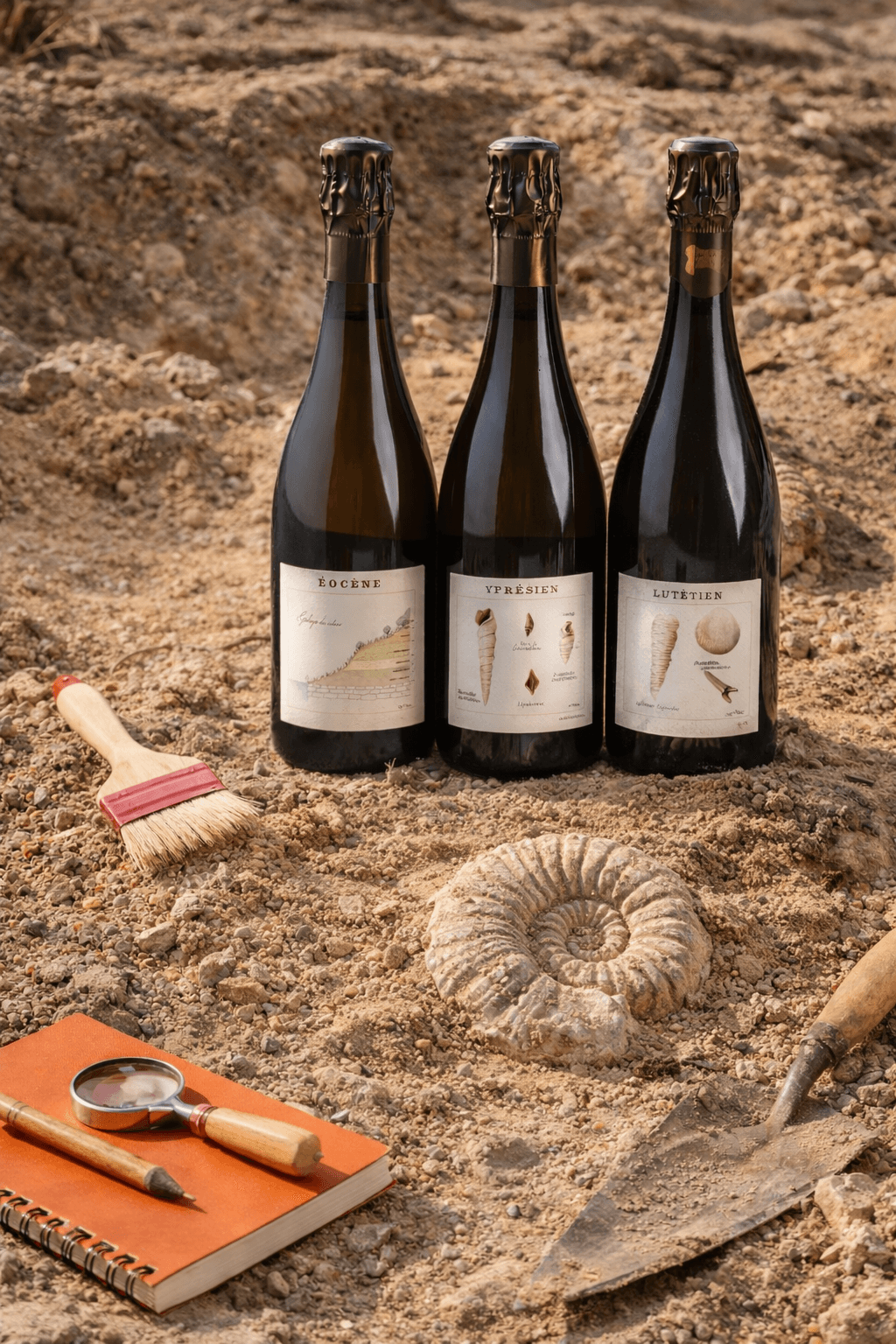
There are geeks and then there are Geeks. At Legrand Latour, the wines are not stylized as much as other houses - they are reflections of the soil types, and in particular, the differing eras of geologic strata that underly the region’s vineyards. This 3-pack includes one of each of the following for a fun investigation of terroir in Champagne.
EOCÈNE - Eocene includes all geologic periods that formed the land 34-56 million years ago. From vineyards grown in clay-loamy, sandy, and green-clay soils in the village of Verneuil, this 50/50 blend of Chardonnay and Meunier is fine-tuned and energetic with lovely weight and length.
YPRÉSIEN - Ypresien is a geologic period from 48-56 million years ago. The successive sedimentations that form this terroir are sometimes from fresh water and sometimes from sea water. From Meunier and Pinot Noir grown in soils of marl, clay, fine sand, and sandstone in the villages of Vandières and Verneuil, this blend has depth and drive with a crunchy mineral underpinning.
LUTÉTIEN - Lutetien is represented by a deposit of calcareous sand, rich in fossilized shells, which bear witness to a tropical sea. 45 million years ago, this sea from the Paris Basin extended as far as Champagne. From vineyards in the village of Vandières, this 50/50 blend of Chardonnay and Pinot Noir has both power and precision with a talcum texture reminiscent of the finest limestone-rich terroirs.
******
In the cellar, Thibault aims to work simply and precisely. Wines are fermented in barrel with native yeast and no additives, except sometimes sulfur, which is only used prescriptively. If the wine is thriving, he adds zero sulfur. Additionally, there are no pumps, and everything is done by gravity. Furthering his quest for wines without artifice, Thibault embraces a risky and rarely employed method for capturing the bubbles in his wines. Other than the cuvée Ypresien, which uses MCR (rectified concentrated grape must) to initiate the secondary fermentation, Thibault chose to add frozen grape juice to all other cuvées to launch the second fermentation. As of the 2020 vintage, he employs the “Agrapart Method” opting to use fresh, unfrozen juice from the following year for the prise de mousse. This approach is not only the way to achieve a Champagne of 100% pure juice, but it also adds no alcohol to the wine, unlike traditional sugar mixture additions that add approximately 1.5% alcohol to the finished wine. This allows Thibault to seek phenolic ripeness and balance in the vineyard without the fear of elevated alcohols in the finished Champagnes. While there is much discussion of this method in the region, it is quite rare to see it applied. Adding frozen juice, though not commonplace, is seen more frequently and will likely be more embraced as growers continue to contend with the challenges of a warming climate.
After bottling, all Legrand Latour Champagnes are aged on the cork for 30-40 months in the family caves, which maintain perfect humidity and temperature. Because the exchange of energy between a wine and its environment is foundational to Thibault’s philosophy, he chooses to do all riddling and disgorging by hand (à la volée)